
How to Develop Judgment as a Product Leader?
The two capabilities that separate leaders who ship features from those who build companies

In the AI-first world, every SaaS company must reimagine what their business will look like in 1, 3, and 5 years. This shift makes one capability more critical than ever: judgment. As the cost of building software drops dramatically, judgment becomes the differentiator.
Judgment in product leadership is the ability to synthesize reality and imagine a better future. Developing judgment requires two capabilities: independent thinking and imagination.
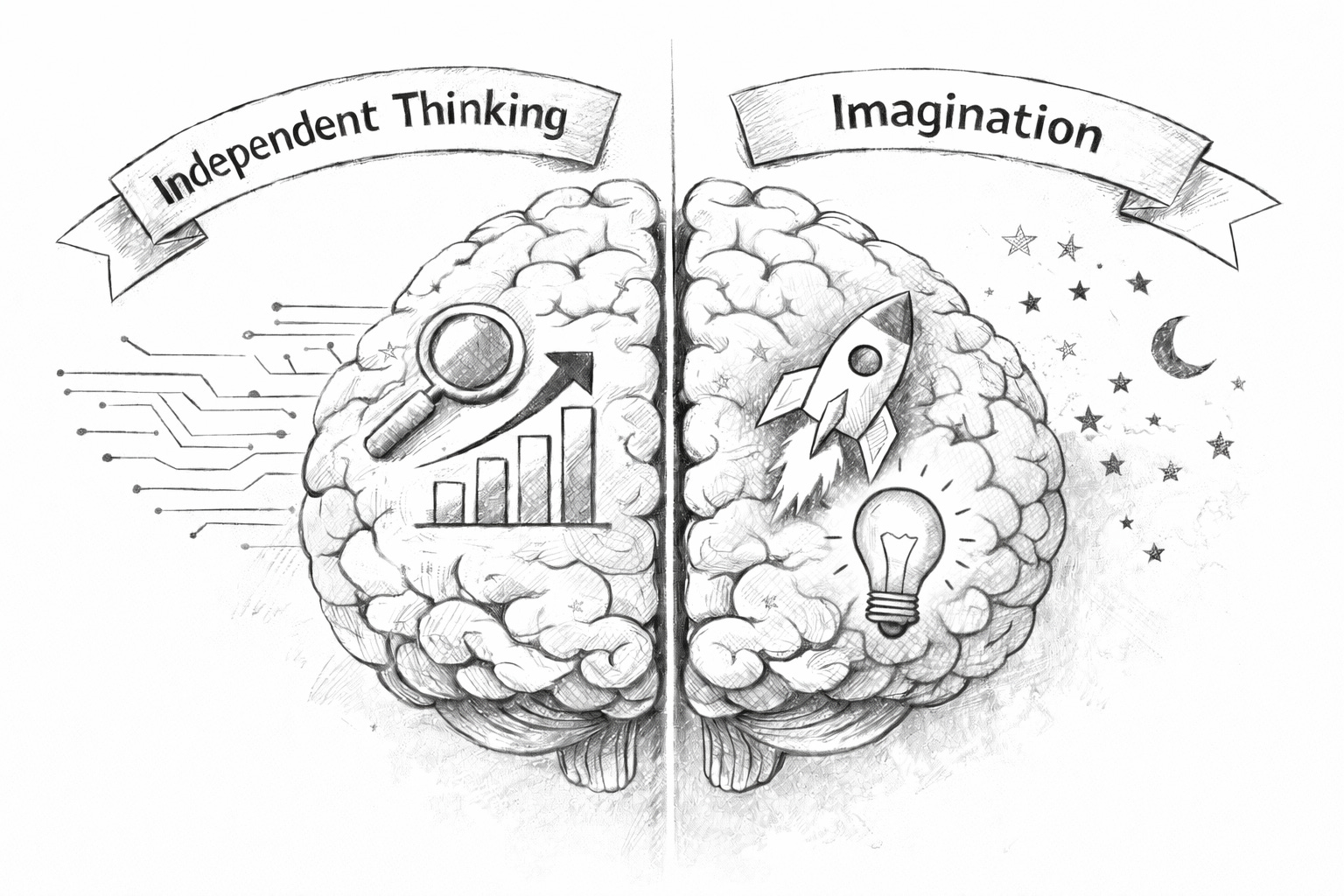
Independent Thinking: Synthesizing Input Variables into a Perspective
Independent thinking means forming your own point of view after absorbing the available signals. It involves continuously processing information and arriving at your own conviction each time.
To develop independent product thinking, you need to synthesize multiple signals that can be broadly categorized as:
Understanding market position
You need a clear understanding of your product’s market position and the differentiators that separate it from competitors. You need to have a deep understanding of your customer pain points and see how your company uniquely serves them.
Understanding market trends
You need to understand where the market is heading across technology, customer habits, and expectations. Markets constantly evolve, and good judgment anticipates where they are going.
Understanding your right to win
You should have a clear perspective on your company’s assets that give you the right to win. These might be technical capabilities, distribution advantages, brand trust, or unique data.
Once you synthesize these signals, you can form a perspective on how your company will win and define the strategic bets and capabilities the product must build. This is often called product strategy and product execution.
When I was at Guidewire, product leadership ensured we identified the right strategic bets through constant customer validation. The roadmap was thoughtfully sequenced, which stood out to me early in my career.
The Big Tech Trap
Unfortunately this is surprisingly hard to find in PMs. There are many reasons for this. In Big Tech, PMs are too busy chasing down what their leadership wants or waiting for other teams to execute to ever come up with an independent perspective on what needs to be built. This happens because incentive structures reward political navigation over product insight, and organizational complexity creates dependencies that discourage bold thinking. PMs often become Project Managers vs Product Strategists.
To be clear, the issue is not talent. Many outstanding PMs work in large tech companies. The challenge is that environments optimized for scale and risk reduction can unintentionally suppress independent thinking. Judgment develops fastest where leaders must constantly decide what to build, what not to build, and how to win.
One way to escape this is to work at an early-stage startup or a later stage startup that is growing with a strong product team. Founder-led companies that have momentum would be a good pick here. Or go start your own business. Learning how to sell, hire, win early customers, and decide what to build next teaches judgment faster than almost any corporate role. When resources are constrained and you constantly think about survival, you develop judgment quickly. I grew the most as a product leader and strategist from my time building Vectro.
Imagination: Designing From the Future Backwards
Unfortunately most of what we are told to do from an early age comes from others: from your parents to the teachers in your school, and then in the corporate world, your managers. This habit of relying on others’ worldviews results in limited rather than limitless thinking.
Limitless thinking encourages imagination and opens up many more possibilities. For a PM, the best way to have imagination is to always design your product or service from scratch to solve customer problems. And then work backwards to what is possible in the present. Here’s what this looks like in practice: instead of asking “what features can we add to our current product?” ask “if we were solving this customer problem from scratch today, with no legacy constraints, what would we build?” Then identify the gap between that ideal and your current state. That gap reveals your roadmap.
I often see PMs start from where the product is today and miss the bigger picture of where it needs to go. They incrementally improve what exists rather than reimagine what should exist.
This approach often reveals the capabilities your org lacks, the partnerships needed, and the pivots that should be considered. At Xero, we are using this approach to build products that are unlocking new opportunities.
Judgment in the AI Era
AI is not just another feature set. It fundamentally changes what products can do and how customers interact with them.
In this context, all SaaS companies need to reimagine what their businesses should look like. It is even more important to hire Product Leaders that have independent thinking and imagination because the old playbooks won’t work. You need leaders who can synthesize messy signals about customer needs, technology, and competitive dynamics into a clear point of view. You need leaders who can imagine products that don’t exist yet.
In a world where software is easier than ever to build, the real challenge is deciding what should exist in the first place.
Judgment is what separates leaders who ship features from leaders who build companies.
Note - Judgment and taste are one half of the equation. You need to bring all of this together in execution where advocacy and discipline play in. More on that later.